
In a dramatic escalation of the Middle East conflict, Israeli forces have launched a series of airstrikes on Beirut, intensifying tensions that now threaten to draw the entire region into open warfare. The attacks, focused on Hezbollah strongholds in the Lebanese capital’s southern suburbs, come just days after the Iran-backed group fired rockets and drones into Israel. With evacuation orders forcing hundreds of thousands to flee and civilian areas already showing signs of heavy damage, the situation has triggered panic across Lebanon and urgent diplomatic interventions worldwide.
What happened
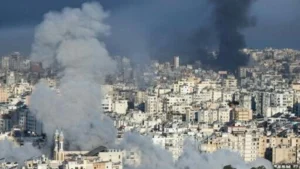
Israeli warplanes struck multiple targets in Beirut’s densely populated southern suburbs late on Thursday and continued into Friday morning, the Israeli Defense Forces (IDF) confirmed. The military described the operation as a precise campaign against Hezbollah’s “terrorist infrastructure,” including command centers and weapons facilities embedded in residential buildings in areas such as Haret Hreik, Burj al-Barajneh, and Hadath.
The strikes follow Hezbollah’s rocket and drone barrage launched on Monday in retaliation for the assassination of Iran’s Supreme Leader Ayatollah Ali Khamenei. That attack pulled Lebanon directly into the broader war between Israel, the United States, and Iran. Since then, Israeli aircraft have hit more than 300 locations across Lebanon, including southern villages, the eastern Bekaa Valley, and even sites near Tripoli.
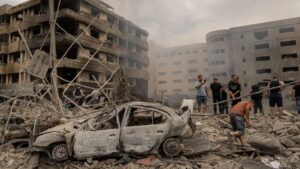
Lebanese health officials report at least 123 people killed and over 680 wounded in the past week of strikes, though the latest Beirut attacks produced no immediate confirmed fatalities. The IDF stated it had destroyed key Hezbollah planning hubs used to coordinate attacks on Israeli civilians and troops. Hezbollah, for its part, vowed to respond forcefully, warning that Israeli aggression against Lebanese sovereignty would not go unchallenged.
Civilian evacuation
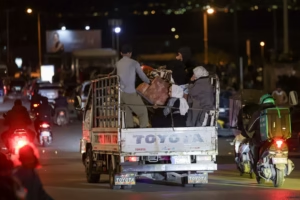
Panic gripped Beirut’s southern suburbs after Israel issued its widest-ever evacuation order for the area, affecting an estimated 400,000 residents. The IDF instructed civilians in the Hezbollah stronghold of Dahieh to leave immediately, citing imminent strikes on military targets hidden among apartment blocks. Roads leading north quickly jammed with cars, while families carried what belongings they could manage.
Thousands more fled from southern Lebanon and parts of the eastern Bekaa Valley after similar warnings. Lebanese state media showed scenes of exhausted residents sleeping in downtown streets, cars, and makeshift beach camps without blankets. The United Nations estimates nearly 100,000 people have been displaced in just days, overwhelming shelters and food kitchens. One resident told reporters he had never seen such chaos in the capital.
The orders have drawn sharp criticism from UN human rights officials, who questioned their compliance with international humanitarian law. Lebanese Prime Minister Nawaf Salam condemned Hezbollah’s actions as “irresponsible” while pleading for calm, even as schools closed and public buildings were converted into emergency shelters.
Global impacts
The fresh violence has sent ripples far beyond Lebanon’s borders. With the United States already conducting strikes on Iranian targets, the conflict now risks spiraling into a multi-front regional war involving Iran’s network of proxies. Oil prices spiked on global markets amid fears of disrupted shipping lanes, while stock exchanges in Europe and Asia opened lower.
France’s President Emmanuel Macron described the moment as one of “great danger” for Lebanon and called for an immediate end to hostilities. Paris announced it would send humanitarian aid to support the displaced. The UN refugee agency warned of a growing humanitarian catastrophe, with thousands more potentially forced from their homes if fighting intensifies.
Hezbollah’s diminished but still potent arsenal and Israel’s determination to neutralize the group have revived memories of the 2024 war. Analysts note that any prolonged campaign could destabilize Lebanon’s fragile economy and trigger fresh refugee flows into neighboring countries already strained by previous crises.
What could happen next
Military observers warn that Israel may be preparing a ground incursion into southern Lebanon, with troops already positioned along the border and tanks visible in forward areas. Hezbollah leader Naim Qassem has promised “utmost sacrifice” in any confrontation, raising the specter of urban fighting in Beirut’s southern districts.
Diplomatic efforts are accelerating. The United States and France are reportedly pressing for a new ceasefire agreement that would require Hezbollah to withdraw north of the Litani River and Israel to pull back from occupied positions. However, Israeli officials have signaled they will not halt operations until Hezbollah’s military capabilities are fully dismantled.
The coming days could prove decisive. Further rocket exchanges, targeted assassinations, or a full-scale invasion would dramatically raise the stakes, potentially dragging in other regional players and complicating global efforts to contain the crisis. For now, the people of Beirut and southern Lebanon brace for what many fear will be a long and painful escalation.